

Arkansas TV Says It Could Face a $6 Million Deficit by 2030. The Reality May Be Worse
The Arkansas Educational Television Commission says it will save at least $2 million a year by ending its affiliation with PBS. It may not be enough.


Yesterday, the Arkansas Educational Television Commission, the governing body of what used to be known as Arkansas PBS, voted to end the state’s affiliation with PBS - the first network to officially do so. “A careful and considerate organization-wide review of operations, partnerships and sustainability revealed that annual PBS membership dues of nearly $2.5 million was simply not feasible for the network or our Foundation,” the network, now known as Arkansas TV, wrote in a release.
In the meeting, the network’s CFO, James Downs, made an interesting observation: In the commission meeting, he remarked that at their current spending rate, Arkansas TV “would have a $6 million deficit by the 2030 fiscal year.”
A deficit of that size - 30% of the network’s total revenue in FY24 - would be devastating to a public television entity that, presumably, has lost federal funding forever. While we can’t see into the network’s day-to-day operations, we can look back into Arkansas TV’s previous financial disclosures to see how much the network already stands to lose this fiscal year and in the next four fiscal years.
Based on Arkansas TV’s financial disclosures alone, it looks like their deficit in FY30 could be much more than $6 million…even after dropping PBS.
The Balance Sheet, Pre-Rescission
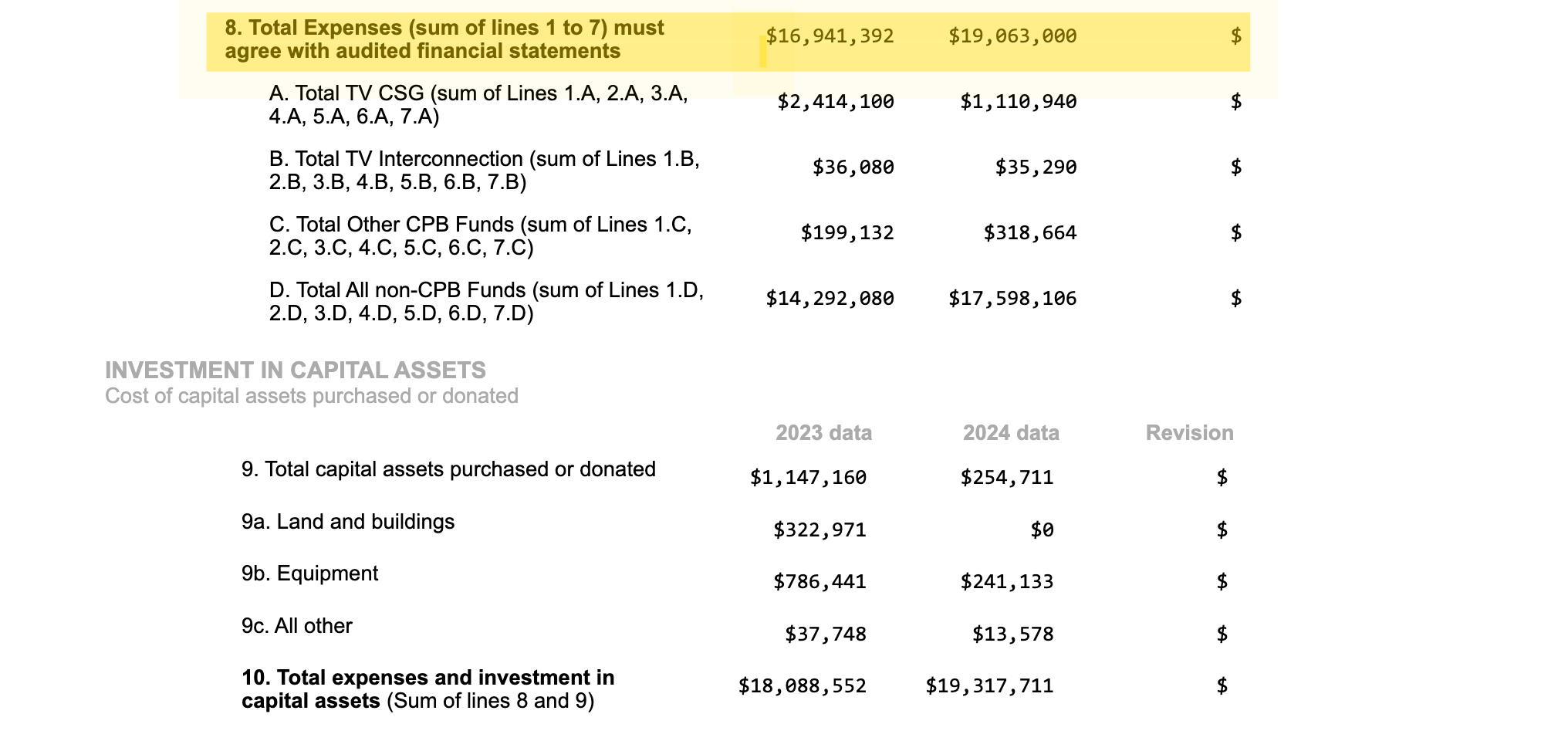
In FY24, Arkansas TV reported a total revenue of just over $20 million on their Annual Financial Report (AFR) to the Corporation for Public Broadcasting. The network received grants from CPB for around $2.6 million. Arkansas Educational Television Network (AETN) also registered grants from the U.S. Department of Education for about $3.3 million (possibly through funds from the CARES and ARP Acts). The previous fiscal year, the network reported a total revenue of $18 million and received similar grants from both entities: About $2.6 million once again from the former, and $2.5 million from the latter.
A quick look at AETN’s audited financial statement from FY24 shows that only about a quarter of the network’s revenue came directly from its stations - the rest came from distributions from other Arkansas state entities.
Conversely, the network reported $19 million in expenses for FY24 and $17 million for FY23 on AFRs for those fiscal years, a net gain of about $1 million for both. On its AFS, AETN also reported $5.6 million in cash on hand in FY24.
Projected Losses
Let’s pretend that AETN’s relative revenues and expenses will stay the same over the next five fiscal years, or until FY30. From an FY24 revenue of $20 million, the network is automatically losing $2.6 million from CPB grants beginning this current fiscal year, FY26. We will also assume that Department of Education grants were not extended during FY25 - either due to grant freezes or the end of CARES/ARPA distributions in Arkansas - subtracting another $3.3 million in revenue from FY25 onward.
One bright spot, as reported by the Arkansas Advocate, is that the foundation was able to find $1.5 million extra to put towards expenses at the end of FY25.
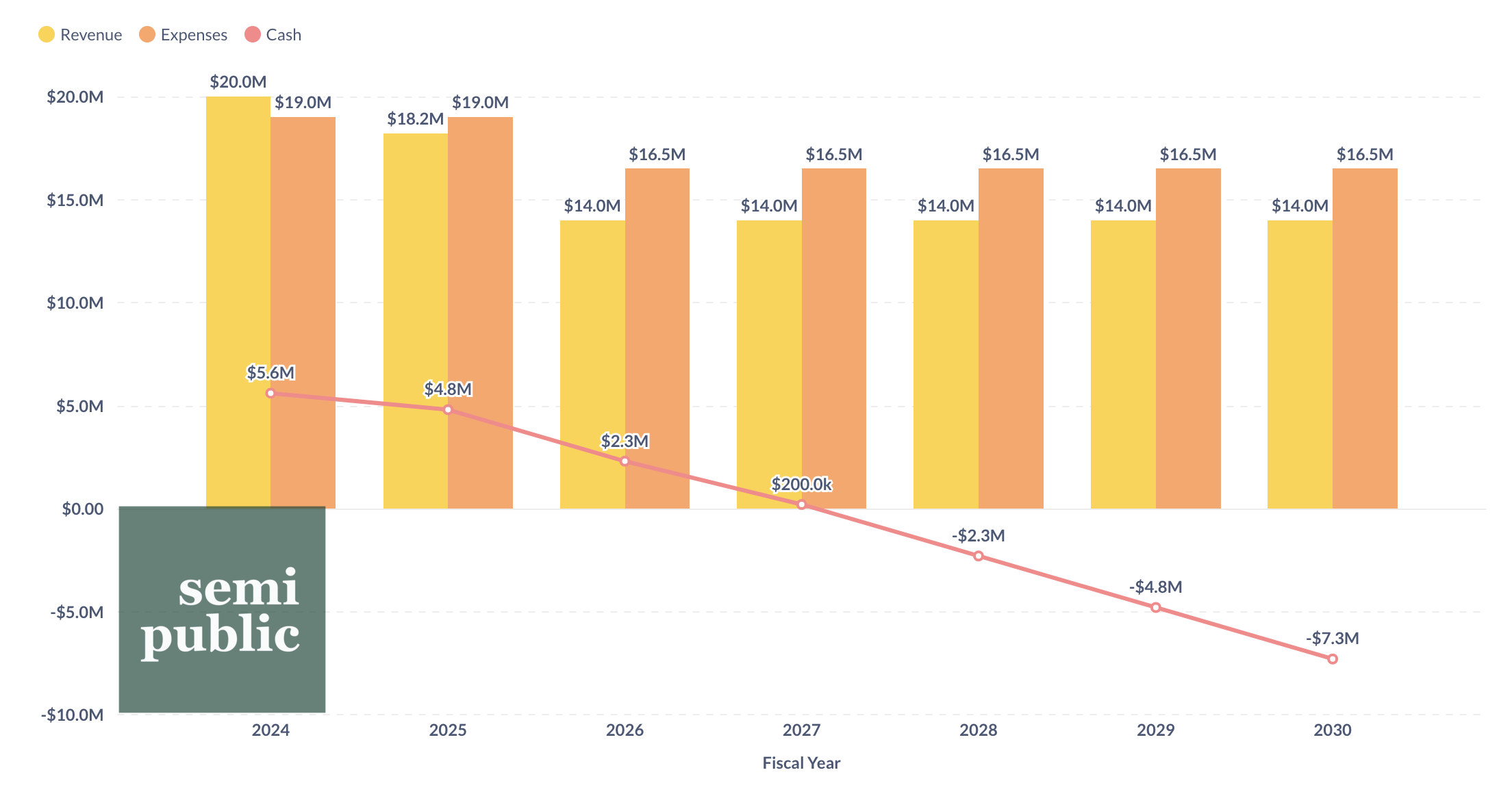
All of this means that in FY25, the AETN’s estimated revenue would have been about $18.2 million - A loss of almost $3.3 million in DOE grants and a slight gain of $1.5 million.
In FY26, however, AETN’s estimated financial woes would begin to grow: Revenue would drop down to about $14 million with the loss of both CPB and DOE grants while estimated expenses would drop to $16.5 million after leaving PBS and saving $2.5 million.
With a starting cash balance of $5.6 million in FY24 and a burn rate of $2.4 million beginning in FY26, it would only take until FY28 for AETN to incur a negative balance.
By FY30, Arkansas Educational Television Network would have an estimated deficit of over $7 million - slightly more than stated in yesterday’s meeting - even after leaving PBS.
Justifying the Means
Yesterday’s decision by AETN to leave PBS is significant because there are many public television stations in a similar predicament that have at least considered taking the same action. AETN was almost certainly looking at a yearly burn rate of twice their PBS dues, any responsible station leader would have to weigh any option to stop the bleeding.
But as I’ve mentioned before, local programming is expensive, especially for public television: Salaries must be paid, studios must be available, electricity for bright lights and heavy cameras must flow. Maintaining the same level of production quality could actually turn out to be more expensive than paying network membership fees.
Only several years of time will tell if AETN’s gamble to drop PBS will help stabilize their budget. In the meantime, any station - radio or television - considering the same action should carefully crunch the numbers to make sure they’re making the right call.
If you enjoyed this post, please consider supporting Semipublic with a paid subscription, or through our GoFundMe. And, as always, please leave a like. It’s very much appreciated.