

Why is NPR Offering Buyouts?
A quick look at the network's audited finances from FY25 shows a banner year for fundraising, but also several warning signs.


Yesterday, NPR President and CEO Katherine Maher announced a buyout program for select newsroom staff. Despite recent large gifts totaling around $113 million to the network, NPR is looking for at least 30 employees to accept a buyout offer out of the 300 that have been offered one, a savings of around $8 million.
"We have to change this organization. We have to think about this audience. We have to think about how they are consuming us. We have to think about the member stations," NPR Editor-in-Chief Thomas Evans told David Folkenflik. "We have to keep what I consider to be the last truly independent newsroom in the country healthy and alive and vibrant."
Back in August, Semipublic estimated that the network was looking at a potential revenue loss of about $14.5 million in station dues due to the federal funding cuts:

In his article on NPR.org, Folkenflik notes that the actual loss-to-date in station dues was around $15 million, and that NPR is “anticipating a drop in corporate sponsorship revenue.” While published finances are typically lagging indicators, today we’ll take a glimpse at NPR’s latest - their audited financial statement from FY25 - to see what else we can determine about yesterday’s news and why the network’s leadership is enacting cuts.
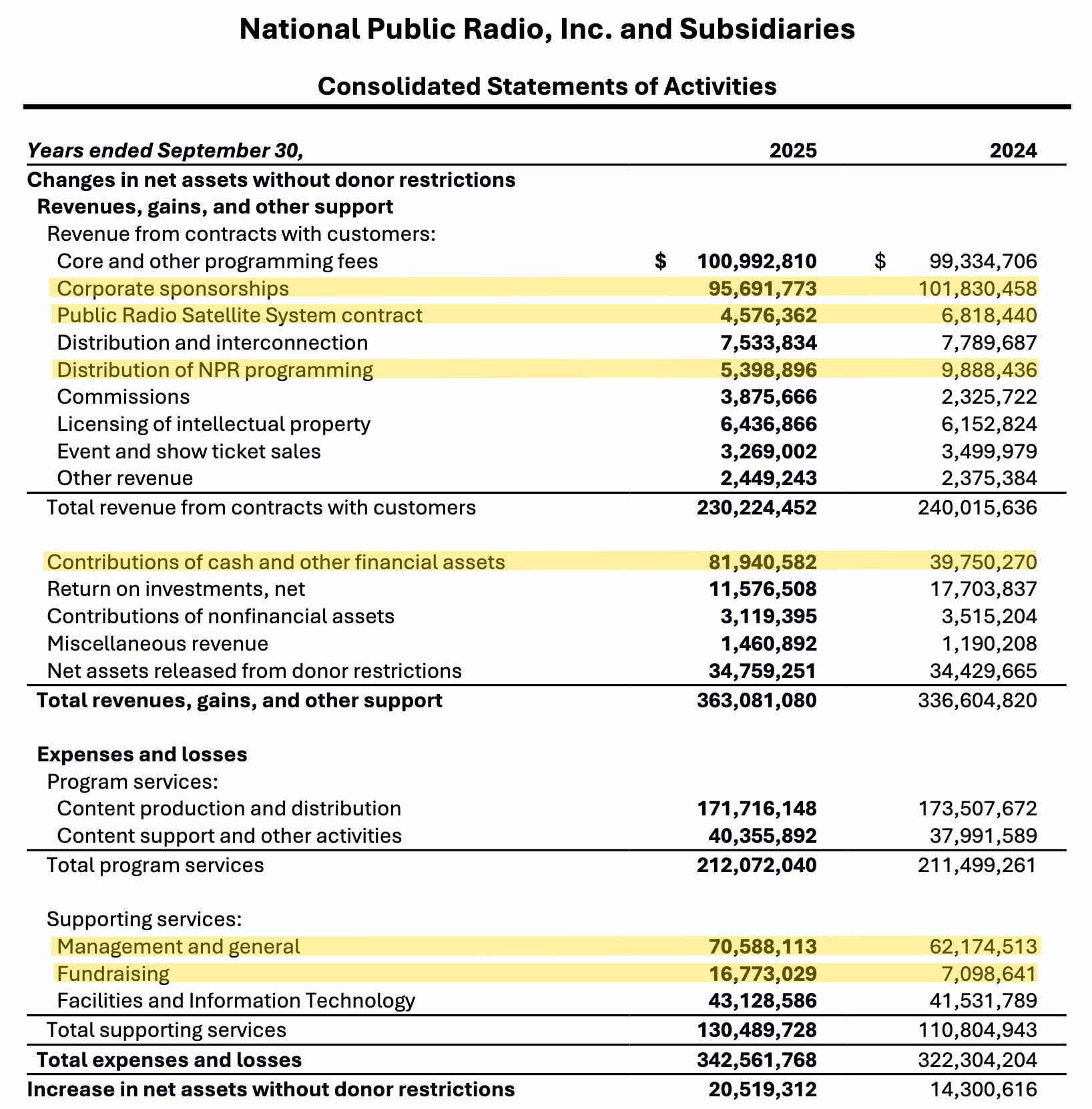
*NPR’s fiscal year runs from October 1 to September 30th, which means that their FY25 audited financial statement only has about two full months of reaction to public media’s federal funding being rescinded. This is also true of station dues, much of which would have already been collected by the rescission vote in mid-July. Therefore, this analysis will not focus on station dues, but other indicators that were present during the entirety of the last fiscal year.
The Good
NPR Had a Banner Year for Contributions
There have been no shortage of articles talking about the explosion in individual and philanthropic giving to NPR and public media in general in the months following the end of federal funding. While much of it happened after NPR’s FY26 year began on October 1st, the network still more than doubled their revenue from financial contributions and grants, from about $40 million to nearly $82 million.
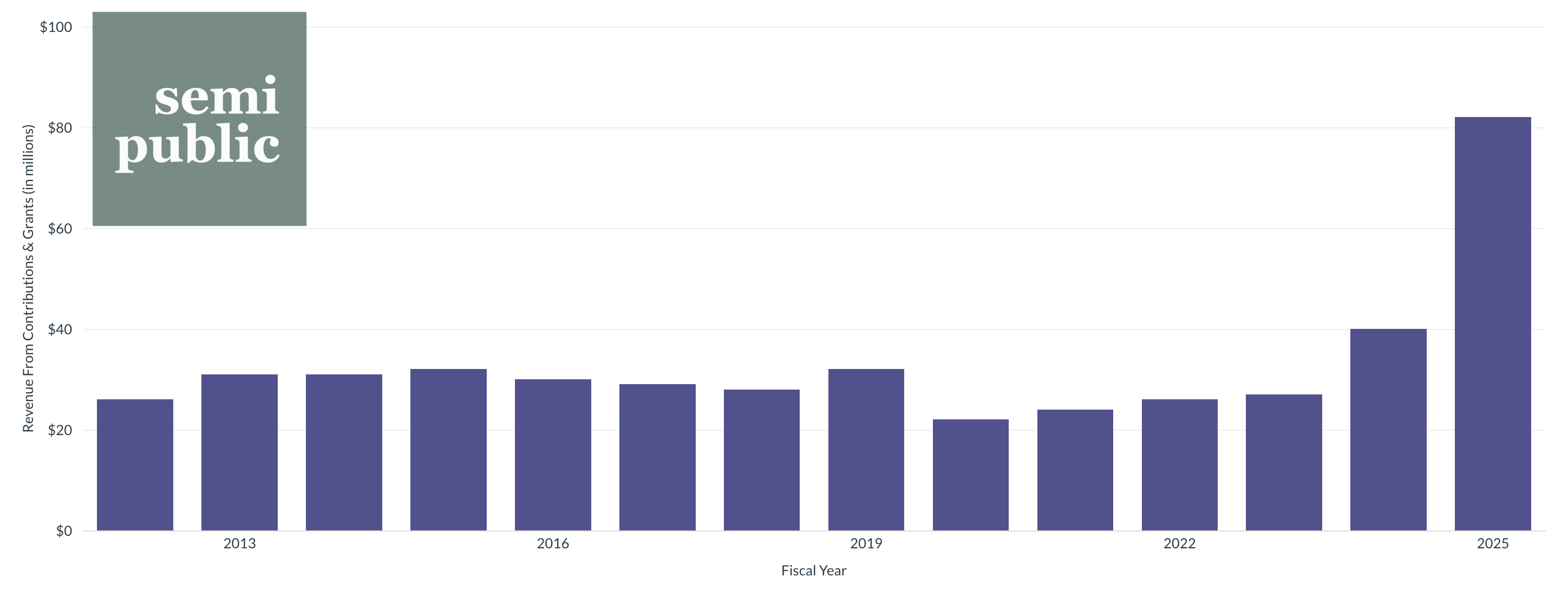
This was an exceptional windfall for the network: NPR has never received more than $40 million in financial contributions since they began separating them out in their audited finances in FY2012. In fact, as you can see in the chart above, their revenue from contributions and grants has been more-or-less consistent for the past 13 years…until FY25.
With last month’s $113 million gifts for digital initiatives, plus an influx of individual donations (yes, you can give directly to NPR) we can almost certainly expect to see the graph pushed even higher in FY26.
The Bad
Distribution is Facing Stiff Competition and Few Routes to Positive Revenue
The Corporation for Public Broadcasting made a powerful statement when it chose to grant $53 million in distribution and interconnection funding to the startup Public Media Infrastructure (PMI) and not the Public Radio Satellite System (PRSS), which is operated by NPR: The future of audio distribution and infrastructure will be digital.
For now, satellite is king for live audio programming because of its incredibly-low latency, but IP-based streaming solutions are a central part of both PRSS’ and PMI’s future plans.
Where it gets financially tricky for NPR and PRSS is the pricing structure of streaming solutions versus satellite: They can charge stations more for the latter because not only is it expensive for NPR to rent satellite capacity and maintain equipment, but there’s also no industry competition. With digital audio distribution, however, not only is it much cheaper for both NPR and stations, but there’s already a mature market of competitors driving the prices even lower.
There are several positives for PRSS following the end of federal funding - their CPB funding was reinstated after a dramatic legal battle and stations’ interconnection fees have been waived for the next two years - but a $7 million loss between NPR’s PRSS contract and programming distribution revenue in FY25 will begin to sting eventually.
Staffing Costs Are Rising
In FY25, NPR spent around $214 million on compensation for staff, a $12 million increase from FY24’s $202 million. This increase was seen across the board in every expense category, with “Management and general” increasing the most by percentage - 10%, or $4 million. (It’s important to note here that I’m pulling these numbers from the functional expenses breakdown in the audited financial statement rather than the statements of activity, which are posted as a screenshot above).
In yesterday’s buyouts announcement, David Folkenflik reported that NPR leadership was hoping achieve $8 million in savings. With inflation at a three-year high, that may not be enough.
NPR Still Has a Sponsorship problem
Back in November 2022, NPR abruptly froze all hiring, citing a projected $20 million shortfall in sponsorship revenue and unfavorable conditions in the media industry. Four months later, their projected deficit increased to $30 million, triggering a 10% reduction in force.
So what actually happened in FY23? As it turns out, the actual shortfall was around $34 million, a 25% drop from $135 million to $101 million between fiscal years 2022 and 2023. Before that, however, NPR experienced staggering growth in sponsorship revenue nearly every year going back to at least FY16, when that revenue was a mere $60 million.
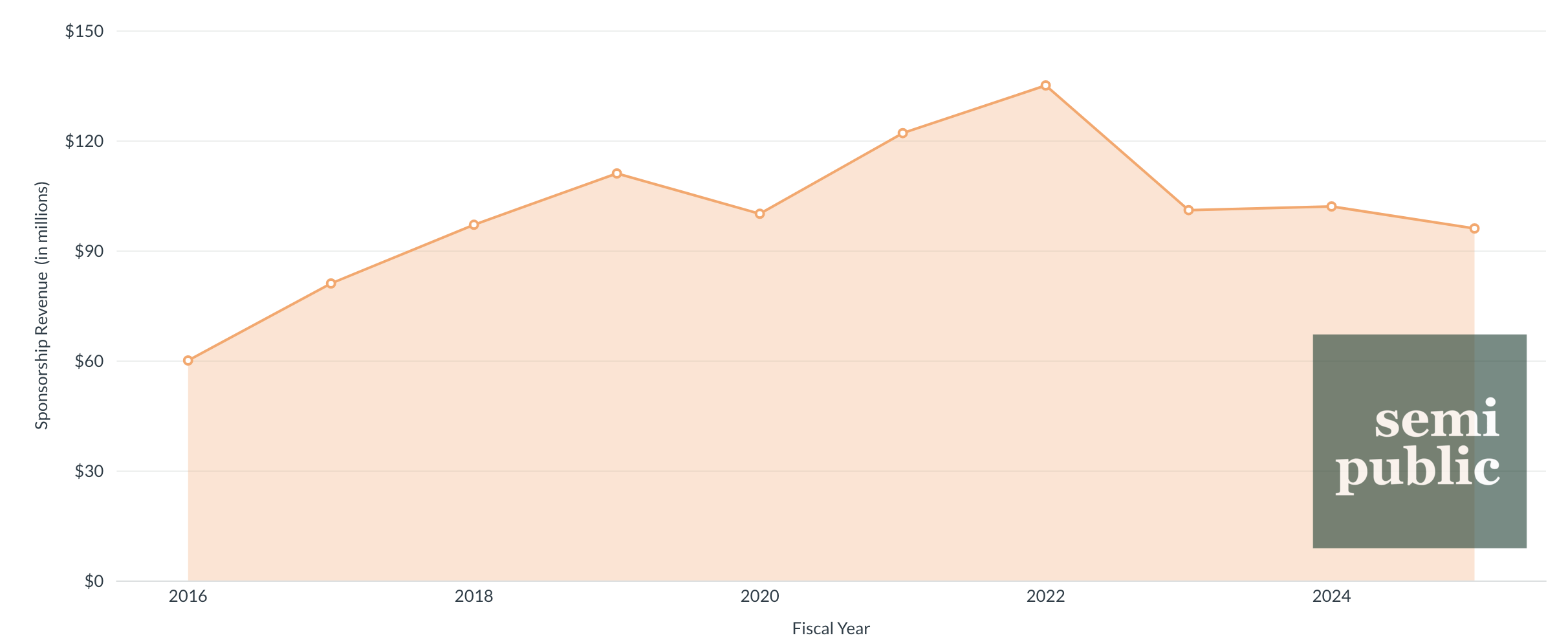
Returning to 2025, the network’s sponsorship revenue dropped from $102 million in FY24 to $96 million in FY25, a number NPR hasn’t seen since 2018. There are two reasons why this $6 million loss - a drop in the bucket, comparatively speaking - would be concerning:
First is that inflation and economic uncertainty have recently been high, depressing ad sales. The collapse of the podcast ad market following the pandemic also didn’t help.
Second is a growing consensus among newsrooms that search engine traffic is dying, if not dead, due to AI. Just last week, Conde Nast CEO Roger Lynch told a podcast that he’d ordered his staff to treat referral traffic as zero in all future projections because of how low their actual numbers were. Search engines drive site views, which in turn drive website ad sales.
There’s no reason to be optimistic about these two conditions improving over the final four months of FY26 or even into FY27. And that’s not even considering the possibility that public media’s entanglements with the Trump Administration may have made supporting the industry a liability for companies that don’t want to draw attention to themselves.
The Conclusion
If we took FY25’s audited finances on their own without any knowledge of what’s happened since September 30th, 2025, it would be difficult to justify buyouts, especially with a massive fundraising year that ended in a $38 million surplus (this includes assets with donor restrictions). It gets a little more difficult when subtracting NPR’s estimated $15 million in station fee losses, but adding in $113 million in major charitable giving (even if it is earmarked for digital initiatives).
However, it does seem unlikely that the budget items that were revenue-negative in FY25 will improve in FY26. There is also growing evidence that the fundraising boom the industry has been enjoying is now waning - trouble that will also flow up to NPR from its member stations.
For now, it seems more likely that these buyouts aren’t a reaction to an immediate problem, but one that will grow over the next three or so years.